
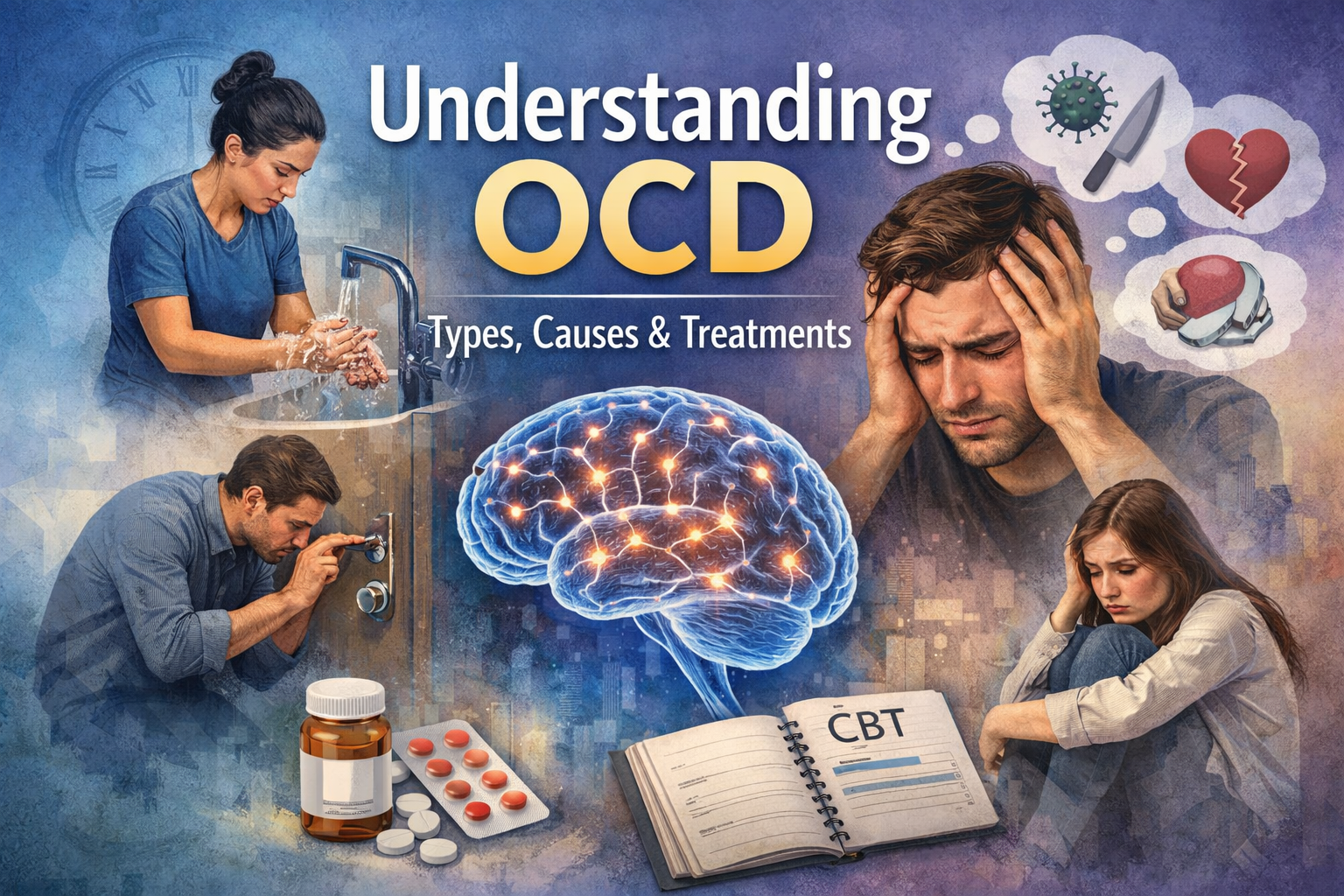
Obsessive-Compulsive Disorder (OCD) is a mental health condition that is often misunderstood, minimized, or inaccurately portrayed in popular culture. While many people casually refer to themselves as “a little OCD,” the lived experience of OCD is far more complex and distressing. It involves persistent, intrusive thoughts (obsessions) and repetitive behaviors or mental acts (compulsions) performed to reduce anxiety. For those who struggle with OCD, these symptoms can consume hours each day and significantly impair functioning.
At its core, OCD is driven by a cycle of obsession and compulsion. Obsessions are unwanted, intrusive thoughts, images, or urges that provoke intense anxiety or discomfort. These may include fears of contamination, harm, or making a mistake. Compulsions are behaviors or mental rituals performed in response to these obsessions, often aimed at preventing a feared outcome or reducing distress (American Psychiatric Association [APA], 2013).
One of the most common forms of OCD is contamination OCD. Individuals with this subtype experience overwhelming fears of germs, illness, or environmental toxins. This often leads to excessive cleaning, handwashing, or avoidance of perceived “contaminated” spaces. While hygiene is adaptive, in OCD it becomes rigid, time-consuming, and anxiety-driven rather than practical.
Another subtype is checking OCD. People with checking OCD are plagued by doubts about safety or responsibility, such as whether they locked the door or turned off the stove. They may check repeatedly, sometimes for hours, to gain certainty. Ironically, the more they check, the less confident they feel, reinforcing the cycle of doubt and compulsion.
A less visible but equally distressing form is harm OCD. This involves intrusive thoughts about causing harm to oneself or others, even when the individual has no desire to act on them. These thoughts can be deeply disturbing and lead to avoidance behaviors or mental rituals aimed at “neutralizing” the fear (Abramowitz, McKay, & Storch, 2017).
Relationship OCD (ROCD) centers on obsessive doubts about one’s romantic relationship. Individuals may constantly question whether they truly love their partner or whether the relationship is “right.” These doubts are not grounded in actual relationship issues but are instead driven by the need for certainty and reassurance.
“Pure O” OCD, a colloquial term, refers to individuals whose compulsions are primarily mental rather than behavioral. These may include rumination, mental reviewing, or silent reassurance-seeking. Although less visible, these internal compulsions are just as consuming and impairing as outward behaviors.
The causes of OCD are multifaceted, involving a combination of biological, psychological, and environmental factors. Research suggests that abnormalities in brain circuits—particularly those involving the orbitofrontal cortex, anterior cingulate cortex, and basal ganglia—play a key role in the disorder (Stein, Fineberg, & Harvey, 2019).
Genetics also contribute to the development of OCD. Individuals with a first-degree relative who has OCD are at a higher risk of developing the condition themselves. Twin studies further support a heritable component, though no single “OCD gene” has been identified (Pauls et al., 2014).
From a psychological perspective, cognitive models emphasize maladaptive beliefs, such as an inflated sense of responsibility or an intolerance of uncertainty. These beliefs lead individuals to interpret intrusive thoughts as significant or dangerous, thereby increasing distress and triggering compulsions.
Environmental factors can also influence the onset of OCD. Stressful life events, trauma, or major transitions may exacerbate symptoms or contribute to their emergence. In some pediatric cases, infections have been linked to sudden-onset OCD symptoms, as seen in conditions like PANDAS (Swedo et al., 2012).
Despite its chronic nature, OCD is highly treatable. One of the most effective treatments is Cognitive Behavioral Therapy (CBT), specifically a technique known as Exposure and Response Prevention (ERP). ERP involves gradually exposing individuals to feared stimuli while preventing the associated compulsive response, allowing anxiety to decrease over time (Foa et al., 2012).
Medication can also play an important role in treatment. Selective Serotonin Reuptake Inhibitors (SSRIs), such as fluoxetine or sertraline, are commonly prescribed and have been shown to reduce OCD symptoms by altering serotonin levels in the brain (APA, 2013).
For individuals who do not respond to standard treatments, alternative approaches may be considered. These include higher-dose SSRIs, augmentation with antipsychotic medications, or newer interventions such as transcranial magnetic stimulation (TMS). In severe, treatment-resistant cases, neurosurgical options may be explored.
An important aspect of treatment is psychoeducation. Helping individuals understand the nature of OCD—particularly the role of intrusive thoughts—can reduce shame and increase engagement in therapy. Many people with OCD fear that their thoughts reflect their character, when in fact intrusive thoughts are common across the general population.
Family involvement can also be crucial, especially when loved ones unintentionally reinforce compulsions by providing reassurance or participating in rituals. Family-based interventions can help reduce accommodation behaviors and support recovery.
Living with OCD can be exhausting, but recovery is possible. Many individuals learn to manage their symptoms effectively and regain control over their lives. Progress may be gradual, and setbacks can occur, but with consistent treatment and support, meaningful improvement is achievable.
Ultimately, OCD is not a quirk or a personality trait—it is a serious and often debilitating condition. Increasing awareness and understanding can help reduce stigma and encourage those who are struggling to seek help. By recognizing OCD for what it truly is, we can foster compassion, promote evidence-based treatment, and support those on the path to recovery.
